
Pines Peak: Merge Travel Games
VIZOR APPS LTD.Puzzle
4.7312.00 Reviews
- Version
- 12607.1.2
- Installs
- 100.00K
- Age Rating
- Everyone
Screenshots
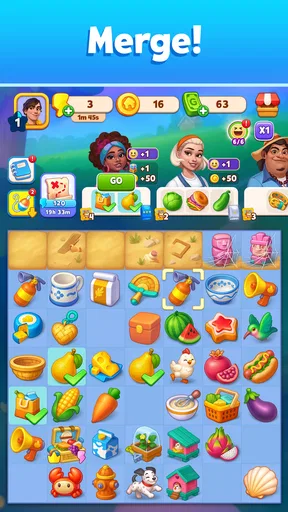


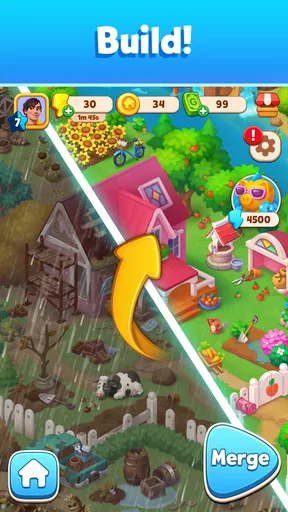



Our Review of Pines Peak: Merge Travel Games
 Analysis by Appyee
I approached Pines Peak: Merge Travel Games as a relaxing puzzle adventure rather than a game meant to be rushed. Its central appeal is the simple act of combining matching objects while gradually spending time in a cheerful world built around a town, a mansion, an island, and a harbor. That sounds familiar if you have played merge games before, but the travel-and-home setting gives the routine a more welcoming personality than a bare puzzle board.
My first impression is that this is best suited to short, repeat visits. I can imagine opening it while waiting for an appointment, making a few combinations, checking what the next task needs, and closing it again without feeling that I have abandoned a complicated strategy session. It is free to start, rated for Everyone, and developed by VIZOR APPS LTD., so its broad presentation is clearly aimed at casual players and families rather than a specialist puzzle audience.
The important question is whether the pleasant setting is enough to carry a merge game through its slower moments. In my view, the answer depends on what you want from the genre. If you enjoy organizing a crowded board, planning combinations, and watching a location become more complete over time, this has a comfortable rhythm. If you prefer quick levels with a clear finish, competitive scoring, or puzzles that demand a different solution every minute, it may feel too gradual.
How the merge loop feels in everyday play
The basic interaction is easy to understand: bring matching pieces together and use the resulting objects to move the surrounding adventure forward. That accessibility is one of the strongest parts of the experience. I did not need a long explanation to understand what the board wanted me to do, and the visual theme makes the activity feel more like tidying and building than solving an intimidating brainteaser.
What makes the loop more interesting is the tension between immediate progress and future space. A tempting combination can clear a little room now, but keeping certain pieces nearby may be more useful when a later request appears. That is the kind of small decision that separates a satisfying session from random tapping. My practical advice is to avoid merging everything as soon as it becomes possible. Leave yourself room to react, especially when the board begins to fill.
This is also where the mansion and travel framing matters. The setting gives the objects a reason to exist beyond the board, so a combination feels connected to a larger journey instead of being an isolated color-matching exercise. I found that useful during longer sessions, because the world provides a gentle sense of direction when the immediate puzzle is simply another chain of merges.
The game is not demanding in the traditional puzzle sense. You are unlikely to spend a long time proving one exact solution in the way you might with a logic-grid game. Instead, the challenge comes from managing choices, space, timing, and the order in which you fulfill requests. That makes it approachable, but it also means players looking for deep deduction should set their expectations accordingly.
Small decisions that make the board easier to manage
One of the less obvious skills is learning when not to complete a chain. A partially developed item can be more useful than a finished one if it leaves flexibility for several possible requests. I recommend scanning the whole board before making a large merge, rather than focusing only on the most obvious pair. This habit reduces the chance of creating a high-level object that occupies valuable space without helping your next objective.
Another useful approach is to treat open spaces as a resource. It is easy to think of empty squares as wasted potential, but in practice they give you room to separate objects, test a combination, and avoid accidental clutter. When I play a merge game in a short break, I am tempted to make fast progress. Here, a slower first pass often produces a cleaner board and a more relaxed second pass.
I also find it helpful to finish a session after a deliberate cleanup rather than stopping immediately after a reward. Leaving the board organized makes the next visit less confusing. That matters in a game designed around returning repeatedly: the real friction is not learning the controls, but remembering what you were preparing and where each item belongs.
What happens when the board becomes busy
The heaviest moments are not necessarily dramatic battles or complex animations. They come when several goals compete for the same limited space and you are holding multiple stages of an item chain. At that point, the game asks for patience. You may need to combine lower-level pieces simply to open a position, even when your preferred move would be to preserve them for a larger result.
This is where the experience can feel slower than a traditional match-three game. A match-three title usually gives me a compact board, a defined turn, and an immediate resolution. Pines Peak instead rewards preparation. I spend more time deciding what to keep and what to combine, and less time reacting to a single move. Neither approach is automatically better, but they suit different moods.
For an everyday example, I could see myself playing during a commute or while taking a short lunch break. I would make a few safe combinations, collect the obvious rewards, and stop before the board became crowded. On a quiet evening, I would be more willing to plan several steps ahead and work through a larger set of requests. The same game serves both situations, but the experience changes depending on whether I play for five minutes or settle in for longer.
Players should also be comfortable with a gradual sense of progress. The satisfaction comes from accumulation: one object becomes another, a request is completed, and the surrounding locations slowly gain purpose. That can be calming, but it can also feel repetitive if you need constant novelty. The game’s strongest moments are about momentum, not surprise.
Speed, stability, and the practical side of playing
From a player’s perspective, this is the kind of game where perceived speed matters more than raw complexity. The board is easy to read, the actions are familiar, and the short-session format makes a responsive feel especially valuable. I would judge it mainly by how quickly I can understand the current task and return to the board, rather than by how many things happen at once.
The current version is 12607.1.2, and the game has reached over 100 thousand installs. Those details suggest an established enough audience for a casual release, while the average rating of 4.7 from around 6.7 thousand ratings indicates that many players find the overall experience appealing. I treat ratings as a useful signal rather than a guarantee, but they fit my impression of a polished, approachable concept.
Resource demands are worth considering because merge games encourage repeated checking. A title that is comfortable in brief sessions should not make the phone feel unnecessarily burdened. I would still recommend closing other demanding apps if your device is older or has limited available memory, particularly before a longer play session. That is not specific to one unusual feature here; it is simply sensible when using any game that keeps a detailed visual board active.
Recovery is another practical concern. My preferred way to use a game like this is to make progress in small pieces, so I value being able to return without having to reconstruct a complicated plan. The best habit is to finish each visit with the board reasonably tidy and your next goal clear. That makes an unexpected interruption less annoying, even when you are playing in a busy environment.
I would not choose this as a background game for a phone that is already struggling with storage or general responsiveness. The free entry point is attractive, but free does not mean frictionless on every device. Older hardware running the minimum supported Android requirement of version 6.0 may offer a less comfortable experience than a newer phone, especially if other apps are active. On a modern device, the casual structure should be easier to live with.
Where the free model affects the experience
The game can be downloaded without an upfront purchase, which lowers the risk of trying it. However, in-app purchases range from $0.99 to $99.99 per item. That is a wide span, and it is the main area where I would ask readers to play deliberately. A merge game naturally creates moments when I want one more action, one more piece of space, or a faster route through a request. Those are precisely the moments when spending can feel tempting.
I recommend deciding before playing whether you are comfortable treating purchases as optional support or whether you want a strictly no-spend experience. The free structure is most enjoyable when I accept the slower rhythm instead of viewing every delay as a problem to solve with money. If you are easily frustrated by waiting or by progress that does not arrive immediately, the purchase design may become more noticeable than the puzzle itself.
This is also a reason I would be cautious about handing the game to a child without supervision. The Everyone rating describes the content as broadly suitable, but purchase controls still matter on a shared device. For family use, I would check the phone’s account and payment settings first. That small preparation is more useful than assuming a child-friendly theme automatically removes every practical concern.
Who will enjoy it, and who should look elsewhere
I think the best audience is someone who likes gentle progression, decorative settings, and puzzles that can be paused at almost any time. It works particularly well for players who enjoy sorting, collecting, and making a messy board gradually more orderly. The travel theme may also appeal if you want a little story atmosphere around your puzzle routine without committing to a long, demanding adventure game.
I would recommend it to a friend who likes merge mechanics but wants more context than a series of disconnected boards. The town, mansion, island, and harbor ideas give the activity a sense of place. They do not transform the genre, but they make the repeated combining feel like part of a larger personal project.
On the other hand, I would steer competitive players toward a game built around timed rankings or head-to-head challenges. I would also suggest a conventional logic puzzle for anyone who wants every level to have a precise answer and a strong mental finish. Compared with those alternatives, this title is more forgiving and more atmospheric, but less focused on pure reasoning.
It may not suit players who dislike managing inventories or revisiting the same board. The satisfaction depends on returning to unfinished chains and remembering what you were building. If that sounds like maintenance rather than entertainment, a short-level puzzle game will probably be a better match. Likewise, anyone who wants constant action may find the deliberate pace too quiet.
My final view on performance and long-term appeal
After looking at the game as both a puzzle and a mobile product, I see its main strength in balance. It is easy to start, comfortable to revisit, and structured around decisions that are simple to learn but not entirely mindless. The most enjoyable sessions are the ones where I plan around space, resist unnecessary merges, and let the setting provide a reason to keep going.
Its limitations are equally clear. The merge formula can become repetitive, crowded boards can slow the decision-making, and the optional purchase range means impatient players may feel pressure to accelerate. Device age and general phone condition will also influence how comfortable repeated play feels, so I would not judge the title separately from the hardware it runs on.
For me, Pines Peak: Merge Travel Games is worth trying if you want a free casual puzzle with a warm travel setting and a progress loop built for short visits. I would approach it as a calm organizing game, not as a demanding test of logic or a fast arcade challenge. VIZOR APPS LTD. has chosen a familiar structure, but the combination of home-building atmosphere and merge planning gives it enough personality to stand apart from the plainest alternatives.
My recommendation is straightforward: try it without spending, keep the board spacious, and decide whether the gradual rhythm fits your habits before investing more time or money. If you enjoy watching small combinations develop into a larger journey, it can become a pleasant daily companion. If you need constant novelty, strict puzzle solutions, or competition, another category of game will serve you better.
Verdict
Strengths of Pines Peak: Merge Travel Games
- Relaxing merge puzzles with a gentle, easy-to-follow pace.
- Travel-themed locations give progression a pleasant sense of discovery.
- Simple controls make it accessible for casual players of all ages.
- Short tasks fit well into quick breaks or daily play sessions.
- Decorating and rebuilding areas adds a rewarding creative element.
Limitations of Pines Peak: Merge Travel Games
- Energy limits can interrupt play during longer sessions.
- Some upgrades and items require patience or repeated merging.
- Progress may feel slow without optional purchases.
- The story is fairly light compared with the puzzle mechanics.
- Limited challenge may disappoint players seeking complex strategy.
Other Releases by VIZOR APPS LTD.
View All
Klondike Adventures: Farm Game
Simulation4.6

Road Trip: Royal merge games
Casual4.4
Similar Picks in This Category
View All
Block Blast!
HungryStudio4.8

Braindom: Brain Games Test
Lahana Game Studio4.6

AMAZE!
CrazyLabs LTD4.6

Sudoku - Classic Sudoku Puzzle
Oakever Games4.7

Art Puzzle - Puzzle Games
Easybrain4.8

Amaze GO!
Oakever Games4.9
Frequently Asked Questions
What is Pines Peak: Merge Travel Games about?
Pines Peak: Merge Travel Games is a casual merge-and-adventure game centered on exploring scenic locations, completing tasks, and progressing through a travel-themed story. You combine matching items to create upgraded objects, then use those objects to fulfill requests, unlock areas, and improve the surrounding environment. The relaxed presentation makes it suitable for players who enjoy light puzzles, decorating, and narrative-driven progression.
How does the merging system work in Pines Peak: Merge Travel Games?
The main gameplay involves combining identical items on the board to produce a more advanced version. These upgraded objects can be used for quests, character requests, and location improvements. Energy or similar resources may limit how quickly you can generate items, so planning your merges is important. Keeping the board organized also helps prevent valuable spaces from becoming blocked during longer play sessions.
Can Pines Peak: Merge Travel Games be played offline?
Some basic gameplay may remain available without a constant internet connection, but online access can be required for downloading game data, synchronizing progress, receiving updates, advertisements, events, or in-app purchase verification. Offline behavior may also vary between Android and iOS versions. For the most reliable experience, launch the game while connected to the internet and check its current store listing for specific offline requirements.
Is Pines Peak: Merge Travel Games free to download and does it include purchases?
Pines Peak: Merge Travel Games is generally available as a free download, but games in this genre commonly include optional in-app purchases. These may offer extra energy, premium currency, boosters, or faster progress. Spending is not usually required to understand the story or enjoy the core merging mechanics, although free players may need to wait for resources to recharge and progress at a slower pace.
Is Pines Peak: Merge Travel Games suitable for children?
The game’s colorful visuals, simple merging mechanics, and relaxed adventure structure can appeal to younger players, but parents should review the age rating and privacy information before installation. Because the title may contain advertisements, online features, or optional purchases, parental controls are recommended. Children may also benefit from guidance when managing limited resources and avoiding accidental purchases through the device’s app store.
Play our best games!


